Advancing Excellence in Emergency Ultrasound Fellowship Training
Amendment
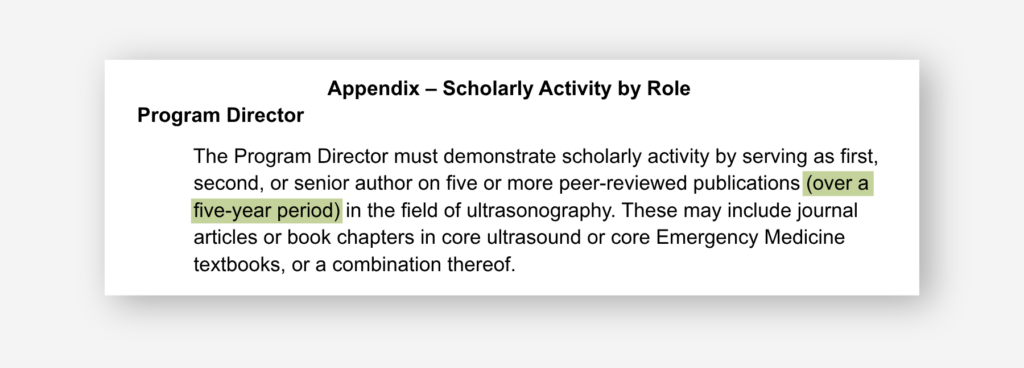
An important amendment has been approved by ABEM to clarify the Scholarly Expectations within the AEMUS Program Requirements. “Over a five-year period” has been added to provide clarification to the intent of the peer-reviewed publication expectation for Program Directors.
The American Board of Emergency Medicine (ABEM) Board of Directors has approved revisions to the Advanced Emergency Medicine Ultrasound (AEMUS) Program Requirements. These forward-looking updates represent a collaborative effort across the Emergency Medicine and Ultrasound communities to strengthen fellowship training standards while promoting fairness and equity in advanced ultrasound education.
The Emergency Ultrasound Fellowship Accreditation Council (EUFAC), established in 2019, is the approval body for AEMUS fellowship training programs. To achieve the mission of providing accreditation to programs, EUFAC evaluates applications for accreditation using published accreditation standards, including fellowship adherence with the program requirements. Graduation from an EUFAC-approved program remains a primary eligibility pathway for ABEM’s AEMUS Focused Practice Designation (FPD).
The revised AEMUS Program Requirements are effective July 1, 2026, for AEMUS fellowship programs.
A central goal of the 2026 revisions is to promote fairness and equity across diverse training environments by focusing on core, generalizable ultrasound content rather than institution-specific practices. By centering on universally applicable competencies, minimum experience thresholds, and standardized scholarly expectations, the requirements support equitable preparation for the AEMUS FPD examination regardless of local institutional resources or practice patterns. This approach ensures that fellows at programs of varying sizes and geographic locations receive comparable foundational training that prepares them for advanced emergency ultrasound practice.
Key Updates
- Enhanced Clinical Experience Standards
- Strengthened Faculty Leadership Requirements
- Elevated Scholarly Activity Expectations
- Adjusted Pass-Rate Thresholds
“The updated program requirements reflect ABEM’s commitment to supporting excellence in fellowship training across the full spectrum of Emergency Medicine training environments,” shared Srikar Adhikari, MD, MS, Chair of the AEMUS Examination Committee. “The revisions establish clearer benchmarks for clinical experience, faculty engagement, scholarly productivity, and program outcomes that distinguish fellowship training from residency-level ultrasound education.”
Review the Updated AEMUS Program Requirements